
Criminal Court Records in Berrien County
A criminal court record is the case file the court opens once a prosecutor files charges against an adult. It grows as the case moves along. Every hearing, motion, plea, ruling, and order lands in the file. By the time a case closes, the record shows the charges as filed, how the defendant answered them, and the outcome the judge entered. This is the case-level record, not a police blotter. For a closer look at the charges themselves and how they change, the Berrien County arrest and court charge records page tracks that side.
In Berrien County, adult criminal matters split across two trial-court levels. The 5th District Court handles the early stages of felony cases and hears misdemeanors and county ordinance violations. The 2nd Circuit Court takes felony cases once they are bound over for trial and sentencing. Felony criminal cases are filed with the county clerk's office, which keeps the official file. The county runs both courts as one coordinated trial court with civil, criminal, family, and probate branches under a single roof in St. Joseph.
The county publishes a plain overview of how adult criminal cases are handled through its Berrien County Criminal Division page, which describes jurisdiction and lists contact details.
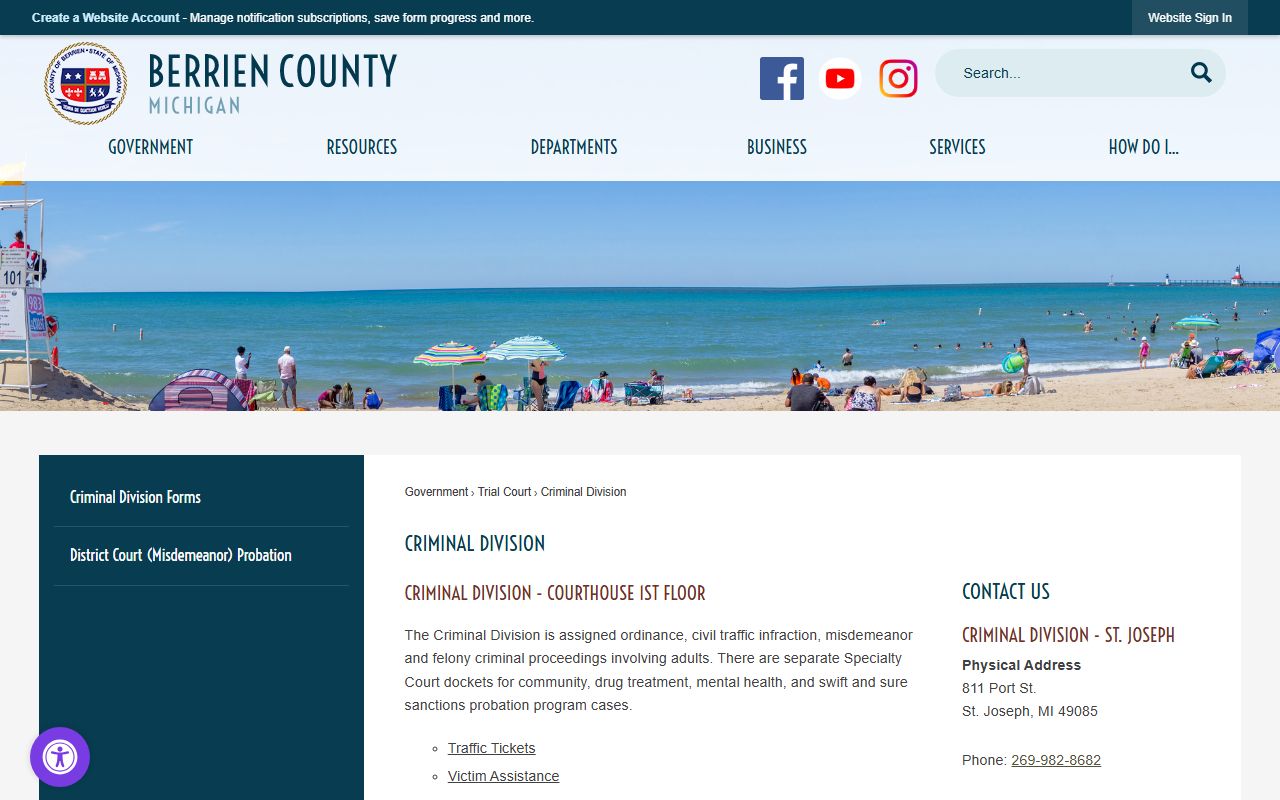
That division page is a good first stop because it confirms which branch of the trial court holds a given criminal file before you request it.
How to Search Berrien County Criminal Court Records
Berrien County does not run a single public portal that searches every trial-court case. Its old Civil Case Search page now says the service is no longer available. That makes the real search counter-driven. The county clerk's records-check counter is the central route for criminal, civil, and family files, and those checks cover Berrien County records only. Court files are public and can be inspected at the clerk's office at the courthouse.
- Gather the defendant's full name, including middle name and any AKA names, plus a date of birth or a year range for older matters.
- Contact the Berrien County Clerk records-check counter in Room 123 at the courthouse, or call the clerk's criminal line for a file check.
- Tell the clerk the record is criminal, and note whether the case was district-court or circuit-court level so it routes to the right file.
- Ask staff to pull the docket so you can read the charges, hearing history, and disposition.
- Request a certified copy from the clerk when you need the record for a legal or official use.
Two statewide tools help when the county counter is not enough. The Michigan Courts case search surfaces appellate and some circuit results, and its snippets list parties, attorneys, and case type, including Berrien Circuit entries. For anyone in state custody or on supervision, the Michigan Department of Corrections OTIS offender search confirms status after sentencing.
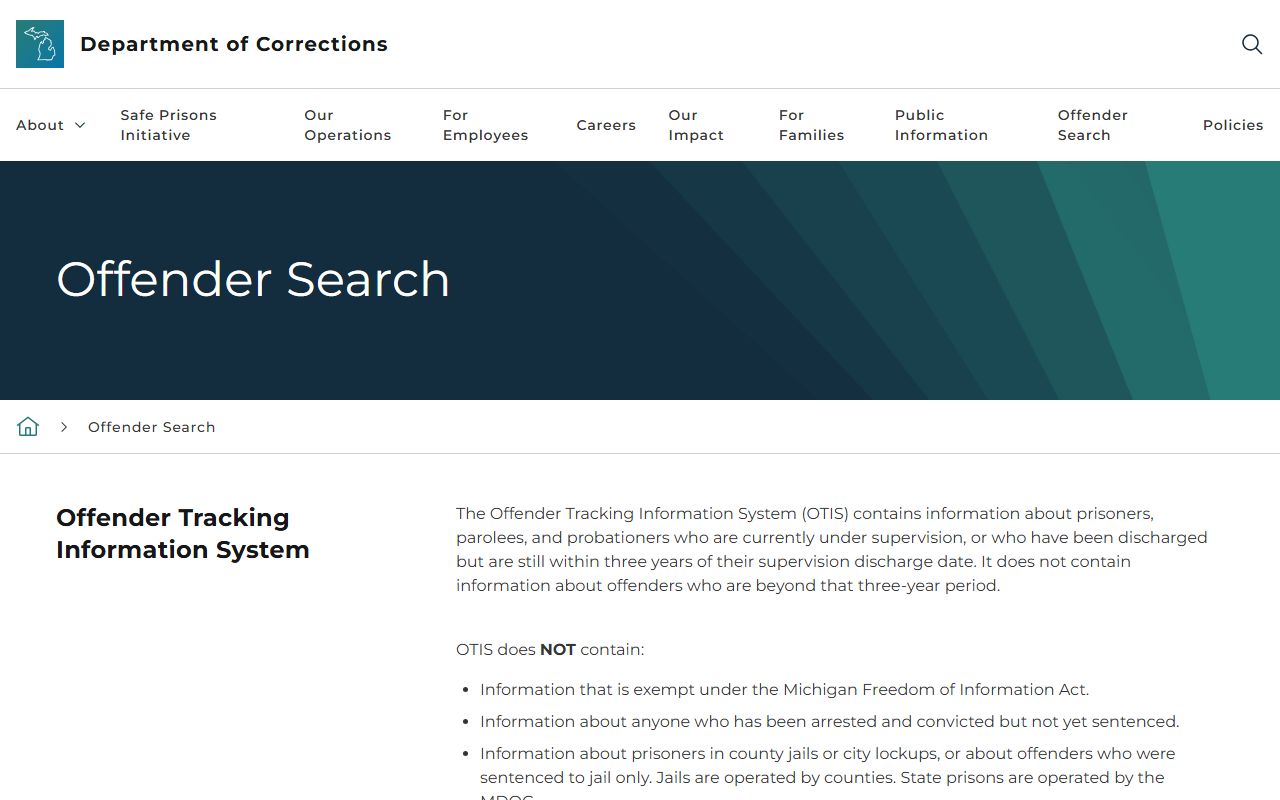
OTIS does not hold the court file, but it ties a name to a prison, parole, or probation record once the case has ended in a conviction and sentence.
Stages of a Berrien County Criminal Case
A criminal case follows a set path, and each step leaves an entry in the record. Reading the docket in order shows exactly where a case stands. Some steps happen in district court and some move up to circuit court, but the sequence is the same.
Case flow: Charges Filed › Arraignment › Pretrial and Motions › Plea or Trial › Disposition › Sentencing
| Stage | What Happens |
|---|---|
| Charges Filed | The prosecutor files a complaint that names the defendant and lists each charge. The clerk opens the case file and assigns a case number. |
| Arraignment | The defendant hears the charges in the first court appearance, enters an early plea, and the court sets bond or release conditions. |
| Pretrial and Motions | Both sides exchange information, argue motions, and discuss a possible plea. Felony cases may hold a preliminary exam before moving to circuit court. |
| Plea or Trial | The defendant pleads guilty or no contest, or the case goes to trial before a judge or jury for a verdict. |
| Disposition | The record shows how the case ended: a plea, a verdict, a dismissal, or a diversion into a specialty court. |
| Sentencing | After a conviction the judge imposes the sentence, which may include jail, prison, probation, fines, costs, and restitution. |
Note: A felony often starts in the 5th District Court and finishes in the 2nd Circuit Court, so a single case can leave entries in two court files.
What a Berrien County Criminal Court Record Shows
The county does not publish its own docket-code glossary, but the fields a reader will meet are consistent across Michigan trial courts. A criminal file pulls together the caption, the charges, the hearing history, and the final numbers. Status labels such as pending, open, disposed, closed, and sealed tell you the current phase at a glance. Case types often carry a short code, and CR marks a criminal matter.
| Field | What It Shows |
|---|---|
| Case Number | The unique file number the clerk assigns, used to pull the docket and any certified copies. |
| Defendant | The name of the person charged, plus known AKA names where they are part of the file. |
| Court and Division | Whether the matter sits in the 5th District Court or the 2nd Circuit Court, and the assigned judge or magistrate. |
| Charges | Each offense as filed, the statute cited, and the severity level as a felony or misdemeanor. |
| Bond | The bond amount or release conditions set at arraignment, and any changes made later. |
| Plea | How the defendant answered: guilty, not guilty, or no contest. |
| Docket Events | Dated entries for each hearing, motion, order, and continuance in the case. |
| Disposition | How the case ended, such as a conviction, a dismissal, or an acquittal. |
| Sentence | The punishment after a conviction, including custody, probation, fines, costs, and restitution. |
Some data never appears in the public copy. Social Security numbers, driver's license numbers, financial account numbers, and juvenile details are redacted under Michigan court rules, even when the rest of the file is open.
Who Files the Charges and Provides Counsel
Charges do not come from the court. In Berrien County, the Prosecuting Attorney reviews police work and decides what to file, then carries the case through district, circuit, family, and appellate matters. That office handles felony and misdemeanor prosecution, juvenile delinquency, and county ordinance enforcement. Every charge in a criminal court record traces back to a filing decision there.
The current prosecutor and the office's duties are described on the Berrien County Prosecuting Attorney page.
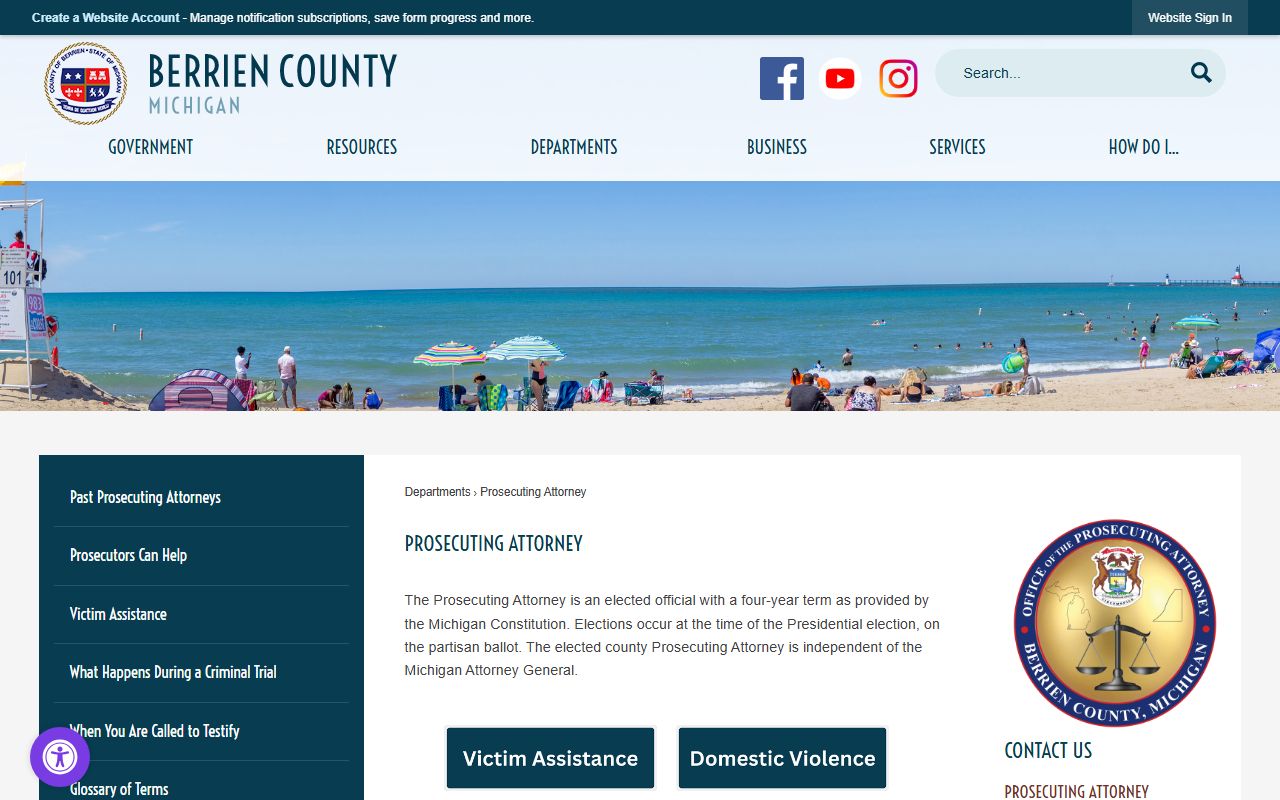
Reading that page alongside a case file helps connect the charges on the docket to the office that filed them.
Berrien County Prosecuting Attorney
Amy Byrd
811 Port Street, 2nd Floor
St. Joseph, MI 49085
Phone: 269-983-7111 ext. 8311
Hours: Monday to Friday, 8:30 AM to 5:00 PM
A defendant who cannot afford a lawyer may qualify for appointed counsel. Berrien County created a Public Defender's Office by resolution in 2016, and it began work in January 2017 as a holistic defense model that uses staff defenders and conflict-panel attorneys. The office accepts appointment requests by form, mail, email, or in person. Its work also shows up in the record, since defense filings and motions become part of the case file.
The office lists its full appointment workflow on the Berrien County Public Defender's Office page.
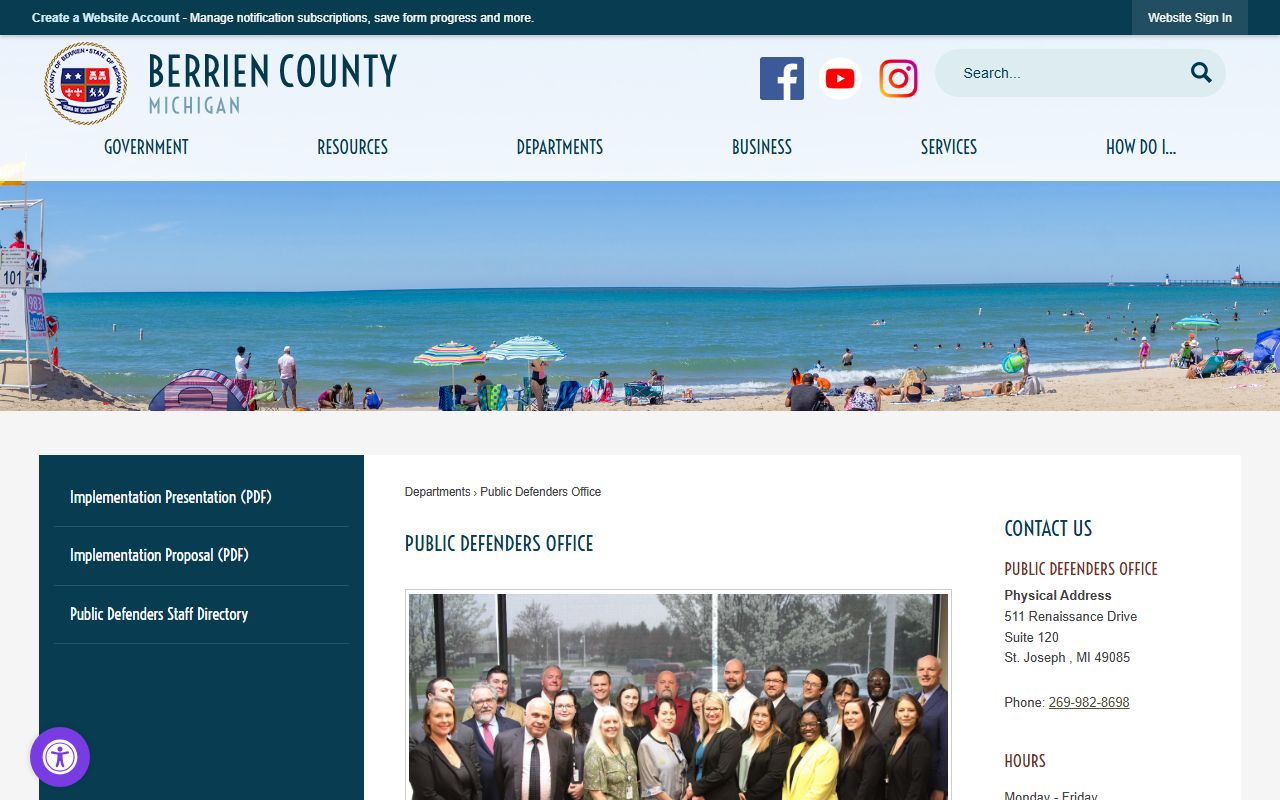
That page is the local contact for appointed counsel, not a general legal-aid directory.
Berrien County Public Defender's Office
511 Renaissance Drive
St. Joseph, MI 49085
Phone: 269-982-8698
Email: requestattorney@berriencounty.org
Hours: Monday to Friday, 8:00 AM to 5:00 PM
Charges vs. Convictions in the Record
A charge is only an accusation. It is not proof of guilt. A criminal court record can show charges that were later reduced, dropped, dismissed, or that ended in an acquittal. The county's own inmate roster warns that charges are an accusation and the defendant is presumed innocent. Reading a file means separating what was filed from what was proven.
| Charge | Conviction | |
|---|---|---|
| Stage | Accusation filed by the prosecutor | Guilty verdict or accepted plea |
| Burden of Proof | Probable cause | Beyond a reasonable doubt |
| Can Change | Yes: amended, reduced, or dismissed | Stands unless appealed or set aside |
| Shown in Record | As filed and as amended | As the final disposition and sentence |
| Public Record | Yes | Yes, unless set aside |
A background check that treats every charge as a conviction gets the story wrong. The disposition line is what settles the outcome.
Reading Dispositions and Sentences
The disposition is the short answer to how a case ended, and the sentence spells out what follows a conviction. A few terms come up again and again in Berrien County criminal files. Knowing them makes the docket readable.
- Disposition
- How the case ended, such as a plea, a verdict, or a dismissal.
- Dismissal
- The case ends without a conviction. With prejudice means it cannot be refiled; without prejudice means it can.
- No Contest
- The defendant does not admit guilt but accepts the conviction and sentence.
- Sentence
- The punishment after conviction, which may combine custody, probation, fines, costs, and restitution.
- Probation
- A supervised community sentence served instead of, or after, time in custody.
- Diversion
- A path such as a specialty court that can lead to a dismissal once the defendant completes the program.
Berrien County runs recovery, wellness, and sobriety courts that can change how a case ends. A file routed into one of those programs may show a plea followed by treatment steps rather than a straight jail sentence.
Sealed vs. Expunged Records
People often use these words as if they mean the same thing, but they do not. Sealing hides a record from public view while the file still exists. Expungement in Michigan is called setting aside a conviction, and it clears the conviction from the public record. Even after a set-aside, the court keeps a nonpublic record, and the state police retain data where the statute allows.
| Sealed | Expunged / Set Aside | |
|---|---|---|
| What Happens | Public access is restricted by court order | The conviction is set aside and cleared from public view |
| Record Still Exists | Yes, but hidden | Yes, as a nonpublic record kept by the court and state police |
| Law Enforcement | Limited access | Very limited, statute-controlled access |
| Eligibility | Set by court rule and case type | Set by Michigan statute, with waiting periods tied to the offense |
| Fines and Costs | Not refunded | Not refunded; already-paid fines, costs, and restitution stand |
A set-aside starts with the right form. Standard cases use form MC 227, misdemeanor marihuana convictions use MC 227a, convictions tied to human-trafficking victimization use MC 227b, and juvenile adjudications use JC 66. The application is filed in the court where the conviction happened, then served on the prosecutor and the Michigan State Police. Waiting periods run under Michigan law, and one felony category requires at least five years before an application. The set-aside statute at MCL 780.621 defines the process, MCL 780.621c lists the exclusions, and MCL 780.621d sets the filing and waiting requirements.
Michigan's statewide expungement resources are gathered on the state's Clean Slate program page.
That page explains which convictions qualify and links the current set-aside forms, which is where most Berrien County residents start an expungement.
Public Access to Criminal Court Records
Criminal case files in Berrien County are public records that can be inspected at the clerk's office, subject to redaction rules. Court files run under Michigan court rules, while general public records run under the state Freedom of Information Act. The two systems work together: access is the default, but protected personal data is removed before a file is released. For records that are not a direct court file, such as some sheriff records, a FOIA request is the right channel.
Key Rules and Statutes:
MCR 1.109 - Court records are public unless specifically restricted, and protected personal data must be redacted.
MCR 8.119 - Governs how courts maintain records and how the public inspects them.
MCL 15.243 - Lets an agency withhold certain personal, law-enforcement, and otherwise exempt information under FOIA.
For the full landscape of what the county keeps and how each channel works, the Berrien County court records overview maps every division and request route.
Restricted Criminal Court Records in Berrien County
Not every criminal-adjacent file is open. Some categories are closed or tightly limited by court rule and statute, regardless of the general public-access default. Knowing which files fall outside public view saves a wasted trip to the clerk's counter.
- Juvenile delinquency and child-protective matters, handled through the family and juvenile division with far narrower access than adult cases.
- Convictions that have been set aside, which leave only a nonpublic record for the court and state police.
- Sealed cases restricted by a specific court order.
- Adoption files, treated as closed unless a court order or statute opens them.
- Mental-health commitment proceedings, which are sensitive and never described as fully open.
- Personal identifiers inside otherwise public files, such as Social Security and account numbers, which are redacted.
If a name turns up in a warrant rather than an open case, the Berrien County warrant records page explains how active warrants are checked and cleared.
Important: This site is not a consumer reporting agency under the Fair Credit Reporting Act, and its records may not be used for credit, employment, housing, or other FCRA-regulated screening.